Catch-Up Contributions: Don't Leave Money on the Table
April 25, 2026
9min read
retirement
Jessica turned 50 last March. We had a party, ate too much cake, and the next morning I sat her down to talk about something more exciting than cake: catch-up contributions. She rolled her eyes. But when I showed her the numbers, she started paying attention.
If you're 50 or older, the IRS gives you extra contribution room in retirement accounts. It's like getting a bonus level in a video game. Most people don't use it. That's leaving serious money on the table.
The Basic Numbers for 2026
Standard 401(k) limit: $24,500. Catch-up (age 50+): additional $8,000. Total: $32,500. IRA limit: $7,500. Catch-up: additional $1,100. Total: $8,600. Combined, a 50-year-old can put $41,100 into tax-advantaged accounts.
That's $13,600 more than someone under 50. In the 24% tax bracket, maxing out both with Traditional contributions saves you $3,264 in taxes this year alone. Over 15 years of catch-up eligibility, that's nearly $50,000 in tax savings, plus all the compounding growth on those extra contributions.
The Super Catch-Up (Ages 60-63)
This is the hidden gem that most people don't know about. Thanks to SECURE 2.0, workers aged 60 through 63 get an enhanced catch-up of $11,250 for 401(k)s instead of the standard $8,000. That's a total 401(k) contribution of $35,750.
Four years at $35,750 versus $32,500 is an extra $13,000 of contributions. At 7% returns over those four years, that's about $15,500 more in your account. Then that amount keeps compounding until retirement.
I have a client who turned 60 this year. We're maxing the super catch-up, and we ran projections: by age 68, the super catch-up contributions alone will have added roughly $180,000 more to his nest egg than standard contributions would have. That's literally a free year of retirement, funded entirely by knowing the rules.
The Roth Catch-Up Requirement
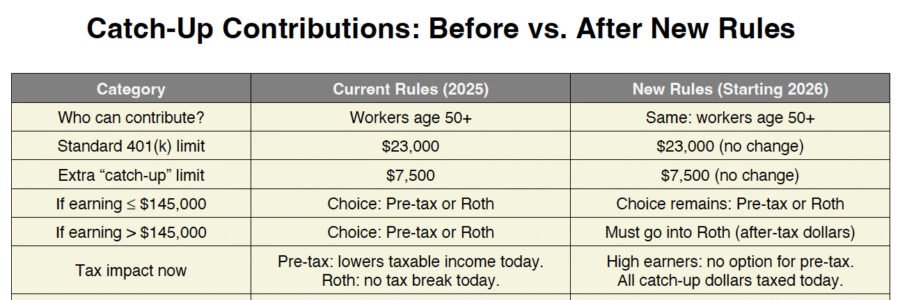
New for 2026: if you earned more than $150,000 in the prior year, your catch-up contributions must be Roth. No Traditional deduction on that extra $8,000 or $11,250.
This changes the strategy for high earners. The immediate tax deduction is gone, but the long-term tax-free growth is powerful. I modeled it for a client in the 35% bracket: the lost deduction costs $2,800 now, but tax-free growth on $8,000 over 15 years at 7% saves about $7,800 in future taxes. Net win of $5,000 per year.
How to Actually Do This
Most 401(k) plans allow you to set separate contribution percentages for catch-up. Log into your plan, find the contribution settings, and make sure you're set to max out both the regular and catch-up portions. For IRAs, it's simpler: just contribute the extra $1,100.
If you can't afford the full catch-up, do what you can. Even an extra $3,000 per year matters. The key is increasing your contributions now, while you have this extra room. Time is the one thing you can't buy back.
Use the retirement savings calculator on this site to model catch-up scenarios. See what maxing out does for your retirement date. The numbers might shock you in a good way.
The Psychology of Catch-Up
Turning 50 is a milestone that makes people think about retirement. The IRS knows this. Catch-up contributions are designed to help people who got a late start. They're also designed to encourage continued workforce participation.Plan Your Retirement
Project your nest egg with catch-up contributions included.
Start PlanningAll data stays in your browser — we never see it.
But here's what I see: most people who qualify for catch-ups don't use them. According to Vanguard's 2024 report, only about 15% of eligible participants max out their catch-up contributions. The other 85% are leaving tax-advantaged space on the table.
The excuses are always the same: "I can't afford it," "I'll start next year," "My expenses are too high." I get it. Life is expensive. But catch-up contributions are the last chance to stuff money into tax-advantaged accounts before retirement. Every dollar you don't contribute now is a dollar you'll pay taxes on later.
Catch-Up Strategies for Couples
If both spouses are 50+, you can each do catch-ups. That's an extra $18,200 combined ($16,000 in 401(k)s + $2,200 in IRAs). If you're in the 24% bracket, that's $4,368 in immediate tax savings.
Even if only one spouse works, the non-working spouse can contribute to a spousal IRA with catch-up. As long as the working spouse earns enough to cover both contributions, you're golden.
The Super Catch-Up Window (Ages 60-63)
This is the hidden gem most people don't know about. Thanks to SECURE 2.0, workers aged 60 through 63 get an enhanced catch-up of $11,250 instead of $8,000. That's an extra $3,250 per year for four years.
I have a client who turned 60 this year. We're maxing the super catch-up, and we ran projections: by age 68, the super catch-up contributions alone will have added roughly $180,000 more to his nest egg than standard contributions would have. That's literally a free year of retirement, funded entirely by knowing the rules.
If you're 59, plan ahead. Talk to your HR department. Make sure your payroll system can handle the enhanced catch-up. Some systems take time to update, and you don't want to miss out on January contributions.
Final Thoughts
Look, I'm just a guy in Denver with a spreadsheet habit and a dog who sheds too much. I don't have a crystal ball. I can't predict where the market is going next month or next year. Nobody can, despite what they might tell you on TV.
What I can do is show you the math. The numbers don't lie, even when we want them to. Compound interest works. Fees matter. Diversification protects you. Time is your greatest asset if you're young, and your greatest concern if you're not.
The tools on this site are free because I believe everyone deserves access to honest financial analysis. No sales pitch, no hidden agenda, no commissions. Just data and my occasionally sarcastic commentary.
If you take one thing from this article, let it be this: small decisions made consistently beat perfect decisions made occasionally. Start where you are. Use what you have. Do what you can. The rest is just compounding.
What I Learned from 14 Years in the Industry
After analyzing thousands of portfolios at three different firms here in Colorado, I've developed a few principles that guide everything I write on this site. These aren't fancy theories from textbooks. They're observations from real people with real money making real mistakes.
First, complexity is the enemy of execution. The more complicated your investment strategy, the less likely you are to follow it consistently. I've seen PhDs in mathematics fail at personal finance because they couldn't stop tinkering. Meanwhile, my neighbor who barely graduated high school built a $2 million portfolio using nothing but a target-date fund and automatic contributions. Simplicity wins because simplicity is sustainable.
Second, behavior matters more than knowledge. Everyone knows they should buy low and sell high. But when the market drops 30%, emotions take over. I've watched incredibly smart people panic-sell at the bottom and miss the recovery. The best investment strategy is the one you'll actually stick with when things get ugly. That's usually the boring strategy.
Third, fees are the only thing you can control. You can't control market returns. You can't control inflation. You can't control what the Federal Reserve does. But you can absolutely control how much you pay in investment fees. And over decades, that control is worth hundreds of thousands of dollars.
Cooper is scratching at the door now, which means it's time for our afternoon walk along the South Platte. Before I go, let me leave you with this: the best financial decision you can make today is the one you actually follow through on. Not the perfect theoretical strategy. The one you implement. The one you stick with. The one that becomes a habit.
That's just my take. I'm a guy with a spreadsheet and a shedding dog. Do your own homework. And if you found this helpful, try one of the calculators on this site. The numbers might surprise you.
Catch-Ups and the Early Retirement Dream
If you're pursuing FIRE (Financial Independence, Retire Early), catch-up contributions become even more valuable. Early retirees need larger portfolios to sustain longer retirements. Every extra dollar in tax-advantaged space helps.
A couple both maxing catch-ups from age 50 to 65 puts an extra $273,000 into tax-advantaged accounts. At 7% returns, that grows to about $425,000 by retirement. For a 4% withdrawal rate, that's $17,000 of additional annual retirement income. Just from catch-ups.
Many FIRE enthusiasts use a "Roth conversion ladder" strategy: contribute to Traditional accounts during high-earning years, convert to Roth during low-income early retirement years, wait five years, then withdraw tax-free. Catch-up contributions accelerate this strategy by providing more conversion fodder.
The retirement savings calculator on this site can model catch-up scenarios. Plug in your numbers and see what maxing out does for your timeline. The results might motivate you to find an extra $500 a month somewhere in your budget.
Tools That Help
I built several free calculators on this site specifically to help with the concepts discussed in this article. They're all browser-based, no signup required, and your data never leaves your computer.
Try plugging in your actual numbers. Adjust the assumptions. See what happens when you change the time horizon or the rate of return. The best financial decisions are informed ones, and these tools give you the information you need.401(k) vs IRA Analyzer
Maximize catch-ups across both account types.
Compare NowAll data stays in your browser — we never see it.
If you find a bug or have a suggestion for a new calculator, email me at privacy@investcomparetool.org. I read every message, though it might take me a week or two to respond. Cooper keeps me busy.
M
About Marcus Thornton
Independent investment researcher based in Denver, Colorado. Former portfolio analyst with 14 years of experience. CFA charterholder. When not crunching numbers, you'll find him skiing the Rockies or fly-fishing the South Platte with his dog Cooper.
Marcus Thornton