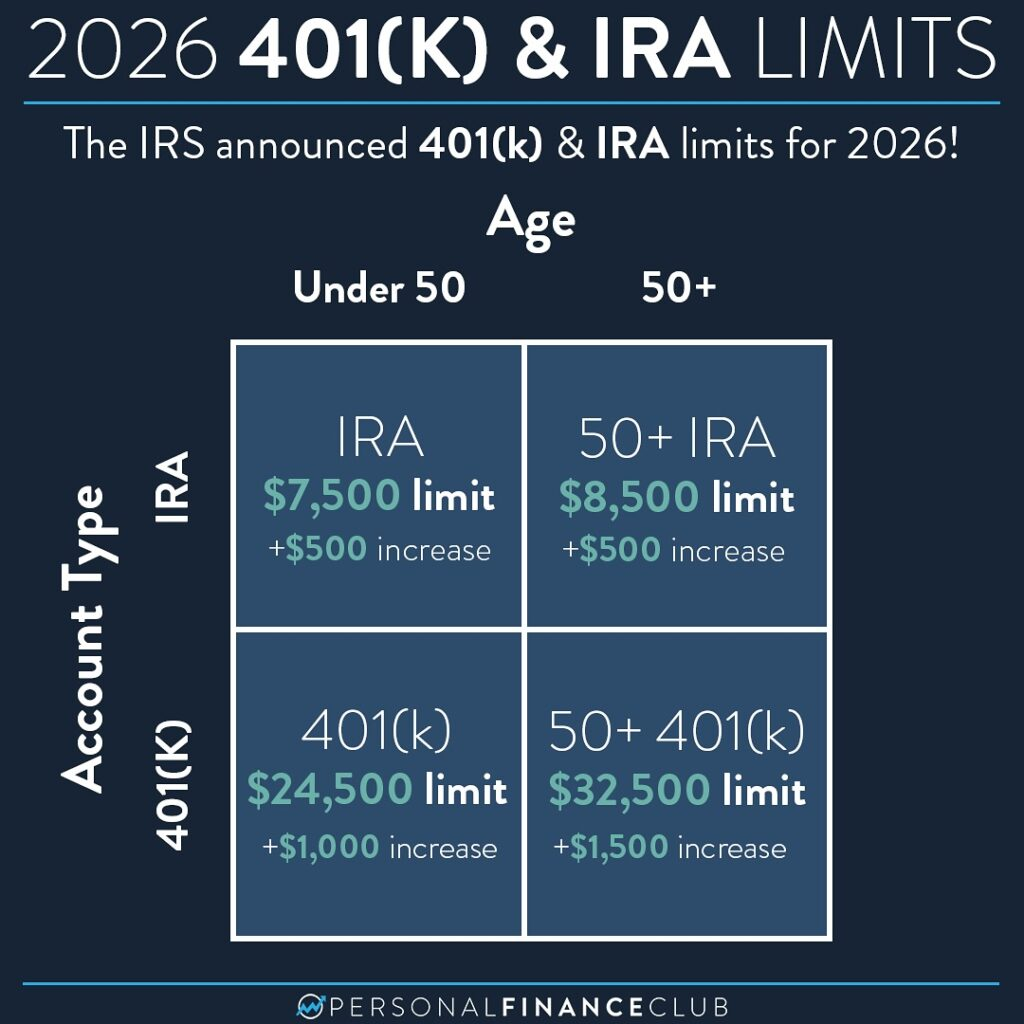
The IRS released the 2026 retirement contribution limits in October, and I immediately got three emails from clients asking the same question: "Should I max out my IRA this year?" My answer, as always: it depends. But the new numbers make the math a little more interesting.
For 2026, the IRA contribution limit is $7,500 if you're under 50. If you're 50 or older, you get an additional $1,100 catch-up contribution, bringing your total to $8,600. That's up from $7,000 and $8,000 last year. The increase is tied to inflation, and inflation has been... generous lately.
Here's what most people miss: the IRA limit is per person, not per household. So if you're married and both of you work, you can each contribute $7,500. That's $15,000 a year going into tax-advantaged accounts. If you're both over 50, it's $17,200. That's real money. Money that grows tax-deferred for decades. Money that compounds while you sleep.
But the income limits matter too. For traditional IRAs, the deduction phases out starting at $79,000 of modified AGI for single filers and $123,000 for married filing jointly. If you make more than that, you can still contribute, but you might not get the tax deduction. Roth IRAs have their own phase-outs: $150,000 for singles, $236,000 for married. Above those limits, you can't contribute directly to a Roth.
I had a client last month who was furious about this. "I make too much for a Roth and too much for a deductible traditional IRA," he said. "What am I supposed to do?" The backdoor Roth, I told him. Contribute to a traditional IRA without deducting it, then convert to Roth. It's perfectly legal. It's a little complex. But it works. He looked at me like I'd told him about a secret passage in his own house.
The catch-up contribution is particularly important for people in their 50s. If you're 50 and you've been under-saving, that extra $1,100 a year is your chance to catch up. Literally. It's not enough to fix thirty years of under-saving, but it's something. And something is better than nothing, which is what a lot of people have.
I ran the numbers for a 52-year-old client who had $180,000 in retirement savings. She needed about $1.2 million to retire comfortably. At her current savings rate, she was going to fall short by $400,000. But by maxing her IRA plus catch-up, increasing her 401(k) contribution, and getting her employer match, she could close most of that gap. It required sacrifice. Less dining out, a cheaper car, delayed vacations. But the math worked. And math, unlike hope, doesn't require faith.
If you haven't checked your 2026 IRA limits, do it now. The deadline for 2026 contributions is April 15, 2027. But the sooner you start, the more time your money has to compound. And compound interest, as someone once said, is the eighth wonder of the world. Or maybe the ninth. I'm not good with quotes. I'm good with spreadsheets.
I also want to mention something that gets overlooked in the IRA conversation: the saver's credit. If your income is below $39,500 for singles or $79,000 for married couples, you can get a tax credit of up to $1,000 for contributing to an IRA. That's not a deduction — it's a credit. A dollar-for-dollar reduction in your tax bill. So you contribute $2,000, you get $1,000 back. That's a 50% instant return, which is better than anything the stock market will give you in a year.
Most of my clients who qualify for the saver's credit don't know it exists. Their tax software might catch it, but it might not. I always ask about income first, then about retirement contributions, then about the credit. It's one of those hidden gems in the tax code that actually helps low-income savers build wealth. And it stacks with the IRA deduction, so you get the deduction AND the credit. The government is basically paying you to save for retirement. I don't know why more people don't take advantage of it. Actually, I do know: because the tax code is a maze and most people don't have a guide.
So here's my advice: check your income. Check your IRA contributions. Check if you qualify for the saver's credit. And if all of this sounds like too much work, hire an accountant. A good one costs less than the money they'll save you. And they'll probably find deductions and credits you didn't know existed. Like the QBI minimum. Like the saver's credit. Like the fact that you can contribute to last year's IRA until April 15th of this year. Time travel, courtesy of the IRS.
— Marcus Thornton
