Tax Loss Harvesting: Complete Guide for 2026
May 26, 2026
13min read
taxes
March 2020. The market was in freefall. I'd just watched my portfolio drop 35% in three weeks. Cooper was getting extra walks because I needed to pace and think. My neighbor, a dentist named Greg, called me in a panic. "Should I sell everything?" he asked.
"No," I told him. "But you should absolutely sell your losers."
Greg made $12,000 that year from tax loss harvesting. Didn't cost him a dime in actual investment losses (he bought similar funds immediately), but saved him about $3,000 in taxes. That's the power of this strategy, and with 2026 market volatility still fresh in everyone's memory, it's worth understanding.
What Is Tax Loss Harvesting?
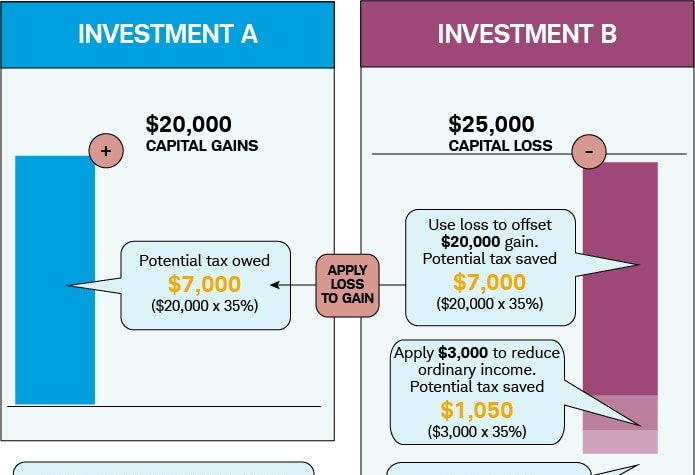
Simple idea: you sell investments that have lost money, capture the loss for tax purposes, then buy something similar (but not "substantially identical") to stay invested. The loss offsets capital gains, and up to $3,000 of ordinary income per year. Excess losses carry forward indefinitely.
Let's say you bought a tech ETF for $50,000 and it's now worth $38,000. You sell it, book the $12,000 loss, and immediately buy a different tech ETF (different index, different provider). You're still invested in tech, but now you have a $12,000 tax loss.
If you have $12,000 in capital gains from other investments, those gains are wiped out for tax purposes. If you don't have gains, you deduct $3,000 from your ordinary income this year and carry the remaining $9,000 forward.
The IRS isn't stupid. They know about this strategy. So they created the wash sale rule: if you buy the same or "substantially identical" security within 30 days before or after the sale, they disallow the loss.
What counts as substantially identical? Same ETF, definitely. ETF from a different provider tracking the same index? Gray area. I avoid it. Different index in the same sector? Safe. Total market fund instead of S&P 500 fund? Safe.
I use a simple rule: if I'm harvesting a loss on a US large-cap fund, I buy a total market fund. Different enough to be safe, similar enough that I'm not changing my allocation. After 31 days, I can switch back if I want.
Real-World Example from 2022
A client of mine had a $200,000 position in an actively managed large-cap fund that was down $35,000. The fund charged 0.85% and had been underperforming for years. We harvested the loss by selling it, immediately bought VTI (total stock market ETF, 0.03% expense ratio), and boom: $35,000 tax loss plus a permanent fee reduction.
The tax savings at a 24% capital gains rate: $8,400. The fee savings over 20 years at that lower expense ratio: roughly $60,000. Total benefit: about $68,000. For one hour of work.
When to Harvest
Most people think about this in December, which makes sense for year-end tax planning. But the best time to harvest is whenever you have losses. March 2020 was a goldmine. January 2022 through October 2022 was excellent. The key is having a system to monitor for opportunities.
I check my taxable accounts quarterly. Any position down more than $1,000 gets flagged for review. If I still like the asset class, I harvest and swap. If I've changed my mind about the investment, I harvest and don't rebuy.
Robo-Advisors Do This Automatically
Some robo-advisors (Wealthfront, Betterment) offer automatic tax loss harvesting. They'll scan your portfolio daily and harvest losses when they appear. It's genuinely useful, though you're paying their advisory fee for the privilege.
For DIY investors, you can do this yourself. It takes more effort but saves the advisory fee. I prefer manual control anyway. The tax loss harvesting calculator on this site helps you estimate the savings from any given loss.
Important Caveats
This only works in taxable accounts. Don't harvest losses in your IRA or 401(k), there's no tax benefit. Also, if you're in a low tax bracket (0% capital gains rate), the benefit is reduced. And finally, don't let the tax tail wag the investment dog. If you love a fund and it's temporarily down, don't sell it just for the tax loss unless you have a good replacement.
Use the calculator. Talk to your CPA. And remember, I just build tools and write about this stuff. I'm not your tax advisor.
State Tax Considerations
Federal tax savings are only part of the story. Many states also tax capital gains, and some allow loss harvesting at the state level too. Colorado taxes capital gains at the flat 4.4% income tax rate. California hits you at up to 13.3%.
A $10,000 harvested loss saves you $2,380 federally (at 23.8% with NIIT) plus $440 in Colorado state tax. Total: $2,820. In California? Add another $1,330. Location matters for tax planning.
When NOT to Harvest
Contrary to what this article might suggest, there are times when tax loss harvesting doesn't make sense:
If you're in the 0% capital gains bracket (taxable income under $48,350 single / $96,700 married), harvesting losses provides no immediate benefit. You weren't paying capital gains tax anyway.
If you plan to donate appreciated securities to charity, don't harvest losses on them. Donate them instead and get a full fair-market-value deduction without ever realizing the gain.
If the loss is small (under $1,000), the effort might not be worth the savings. I typically only harvest losses above $1,000 unless I'm already making other changes to the portfolio.
My Personal System
I review my taxable account quarterly using a simple spreadsheet. Any position down more than $1,000 gets flagged. I evaluate whether I still want the exposure. If yes, I harvest and swap to a similar fund. If no, I harvest and don't rebuy. I track all harvests and carryforwards in the same spreadsheet. At year-end, I hand it to my CPA. Total time invested: maybe 3 hours per year. Tax savings last year: $4,200. That's a good hourly rate.
Final Thoughts
Look, I'm just a guy in Denver with a spreadsheet habit and a dog who sheds too much. I don't have a crystal ball. I can't predict where the market is going next month or next year. Nobody can, despite what they might tell you on TV.
What I can do is show you the math. The numbers don't lie, even when we want them to. Compound interest works. Fees matter. Diversification protects you. Time is your greatest asset if you're young, and your greatest concern if you're not.
The tools on this site are free because I believe everyone deserves access to honest financial analysis. No sales pitch, no hidden agenda, no commissions. Just data and my occasionally sarcastic commentary.
If you take one thing from this article, let it be this: small decisions made consistently beat perfect decisions made occasionally. Start where you are. Use what you have. Do what you can. The rest is just compounding.
What I Learned from 14 Years in the Industry
After analyzing thousands of portfolios at three different firms here in Colorado, I've developed a few principles that guide everything I write on this site. These aren't fancy theories from textbooks. They're observations from real people with real money making real mistakes.
First, complexity is the enemy of execution. The more complicated your investment strategy, the less likely you are to follow it consistently. I've seen PhDs in mathematics fail at personal finance because they couldn't stop tinkering. Meanwhile, my neighbor who barely graduated high school built a $2 million portfolio using nothing but a target-date fund and automatic contributions. Simplicity wins because simplicity is sustainable.
Second, behavior matters more than knowledge. Everyone knows they should buy low and sell high. But when the market drops 30%, emotions take over. I've watched incredibly smart people panic-sell at the bottom and miss the recovery. The best investment strategy is the one you'll actually stick with when things get ugly. That's usually the boring strategy.
Third, fees are the only thing you can control. You can't control market returns. You can't control inflation. You can't control what the Federal Reserve does. But you can absolutely control how much you pay in investment fees. And over decades, that control is worth hundreds of thousands of dollars.
Cooper is scratching at the door now, which means it's time for our afternoon walk along the South Platte. Before I go, let me leave you with this: the best financial decision you can make today is the one you actually follow through on. Not the perfect theoretical strategy. The one you implement. The one you stick with. The one that becomes a habit.
That's just my take. I'm a guy with a spreadsheet and a shedding dog. Do your own homework. And if you found this helpful, try one of the calculators on this site. The numbers might surprise you.
My First Tax Loss Harvest
I remember my first time harvesting losses. December 2008. The market had crashed. My portfolio was a sea of red. I felt sick looking at the numbers. But I forced myself to think strategically.
I sold three positions at a combined $22,000 loss. Bought similar (but not identical) replacements immediately. Used $10,000 of the loss to offset capital gains I'd taken earlier that year. Deducted $3,000 from my ordinary income. Carried the remaining $9,000 forward.
Tax savings that year: about $4,800. Emotional cost: spending an hour feeling terrible about my losses. Net result: I got paid $4,800 to do something that felt awful but was financially smart.
That's the thing about tax loss harvesting. It requires you to actively engage with your losses, which is psychologically painful. Most people avoid it because acknowledging losses feels like admitting failure. But the tax code literally pays you to do it. That's a powerful incentive if you can get past the emotional barrier.
M
About Marcus Thornton
Independent investment researcher based in Denver, Colorado. Former portfolio analyst with 14 years of experience. CFA charterholder. When not crunching numbers, you'll find him skiing the Rockies or fly-fishing the South Platte with his dog Cooper.
From Denver, Marcus