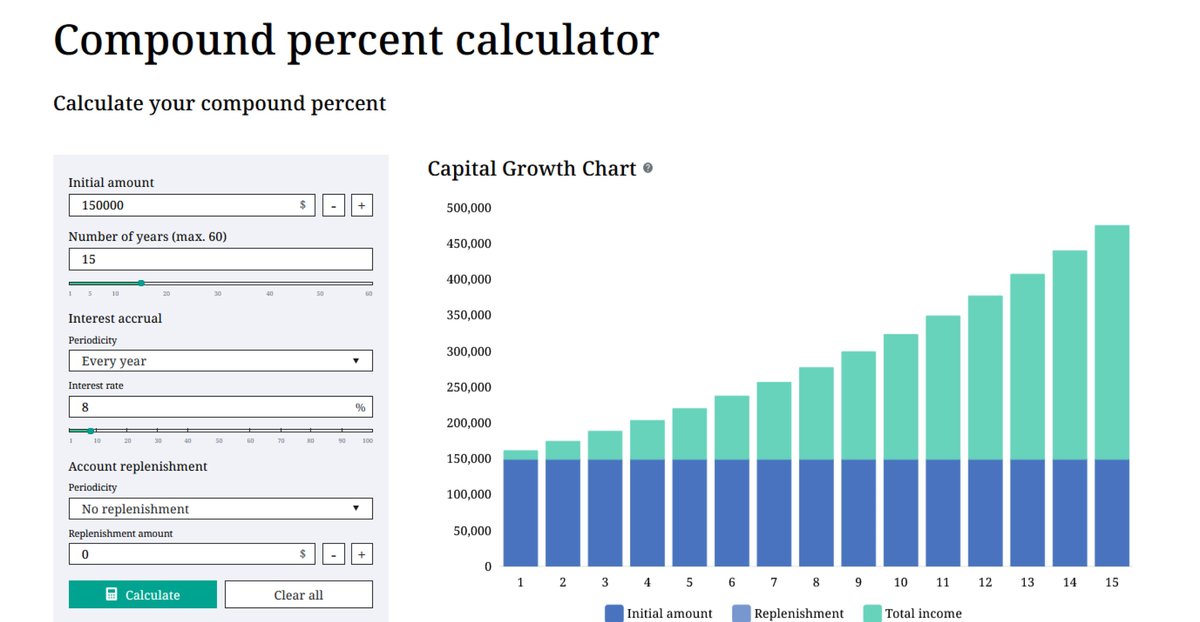
Cooper knocked over my coffee last Tuesday morning. I was staring at a spreadsheet showing a client's 30-year projection, and my golden retriever decided that was the perfect moment to remind me that breakfast was 15 minutes late. As I mopped up Colombian dark roast from my keyboard, I kept thinking about the numbers on that screen. $847,000 difference. That's what believing the wrong compound interest myths had cost this person.
I've been running these calculations for 14 years now, first at a wealth management firm downtown Denver, then here on this site. And the same bad ideas keep showing up like unwanted relatives at Thanksgiving. Let me walk you through the five compound interest myths that I see costing people real money.
Myth 1: "A Small Rate Difference Doesn't Matter"Try Our Compound Interest Calculator
See how much your money could grow with compound returns over time.
Calculate NowAll data stays in your browser — we never see it.
Here's the thing. I hear this one at least once a week. "Marcus, it's only half a percent. Who cares?" Well, I built a calculator that cares, and you should too.
Take $10,000 invested monthly at $500. Over 30 years at 7%, you end up with about $609,000. Drop that to 6.5% and you're at $557,000. That's $52,000 less. For a lousy half percent. I've seen people pick a fund with a higher expense ratio because "the returns are a bit better" without running this math. Don't be that person.
Last month I was reviewing a portfolio for a teacher down in Colorado Springs. She'd been in a 401(k) fund charging 1.2% for six years. The equivalent index fund? 0.04%. I showed her the projection. She went pale. Six years of compounding at the wrong rate, and she was already $23,000 behind where she could have been.
Myth 2: "Compound Interest Works the Same for Everyone"
Time is the secret ingredient, not just the rate. I started investing at 25. Barely. My first 401(k) contribution was maybe $50 a month because that's all I could afford fresh out of CU Boulder working as a research assistant. But that money has been compounding for 16 years now.
My brother-in-law? He started at 38. Smart guy, makes more than I do, but he missed those extra 13 years. Even contributing double what I put in, he's projected to end up with less at retirement. The math is brutal and it doesn't care about your feelings.
The point isn't to make anyone feel bad. It's to start where you are. Twenty-two and reading this? You're golden. Forty-five and just getting started? Better now than fifty.
Myth 3: "You Need a Lot of Money to Start"How Much Are Fees Costing You?
Compare fee structures and see the long-term impact on your wealth.
Compare FeesAll data stays in your browser — we never see it.
This one drives me nuts. I hear it from people making $80,000 a year who think they need $10,000 saved up before they can "really invest." That's backwards.
The magic of compounding works on any amount. $100 a month at 7% for 30 years is $121,000. Not retirement money by itself, but not nothing either. And here's what people miss: the habit matters more than the amount. Getting used to investing monthly, watching it grow, learning not to panic when the market dips. That behavioral foundation is worth more than the actual dollars in the early years.
When I first started, I literally invested $25 a month. Couldn't afford more. But I built the muscle. By the time I got my first raise, increasing it to $100 felt natural. Then $200. The compounding worked on my behavior as much as my money.
Myth 4: "The Average Return Is What You'll Get"
Cooper just sighed. He does that when I'm about to rant. But this one deserves a rant.
People see "the S&P 500 averages 10% annually" and think they'll get 10% every year. Nope. You'll get 22% one year, negative 12% the next, 8% the year after that. The sequence matters enormously.
If the market crashes right before you retire, that "average" return doesn't help you much. This is why I get increasingly conservative with allocation as clients approach retirement. You can't eat average returns when you're pulling money out during a downturn.
My rule of thumb? Plan for 6-7% long-term in your projections. If you get more, great. But don't build your retirement plan on the hope that the 2020s will repeat the 2010s.
Myth 5: "Compound Interest Only Applies to Investing"
Oh, this is my favorite because it's so wrong and so costly. Compound interest works against you too. Credit card debt at 22%? That's compounding. Student loans? Compounding. That car loan? You guessed it.
I had a client once who was contributing $500 a month to his 401(k) while carrying $15,000 in credit card debt at 24% APR. The math was working against him faster than it was working for him. We shifted strategy: pause the 401(k) contributions down to the match minimum, throw everything at the debt, then resume. Saved him probably $40,000 over three years.
Compound interest is a tool. It doesn't care whether it's helping or hurting you. You have to make sure it's pointed in the right direction.
The Bottom Line
Look, I'm not here to sell you anything. I built these calculators because I got tired of watching smart people make expensive mistakes based on bad information. Use the compound interest calculator on this site. Plug in your real numbers. See what small changes actually do over decades.
And remember: the best time to start was yesterday. The second best time is today. Cooper agrees, and he's already back to napping. Smart dog.