Dollar-Cost Averaging: Complete Guide
May 05, 2026
10min read
strategy
I inherited $50,000 from my aunt in 2018. Well, not inherited exactly. She gave it to me before she passed, told me to "do something smart with it." I stared at that check for two weeks. Fifty thousand dollars. More money than I'd ever had at once.
The question was: invest it all at once, or spread it out? Dollar-cost averaging versus lump sum. I did the research. Then I did what the data suggested. Here's what I learned.
What the Research Actually Says
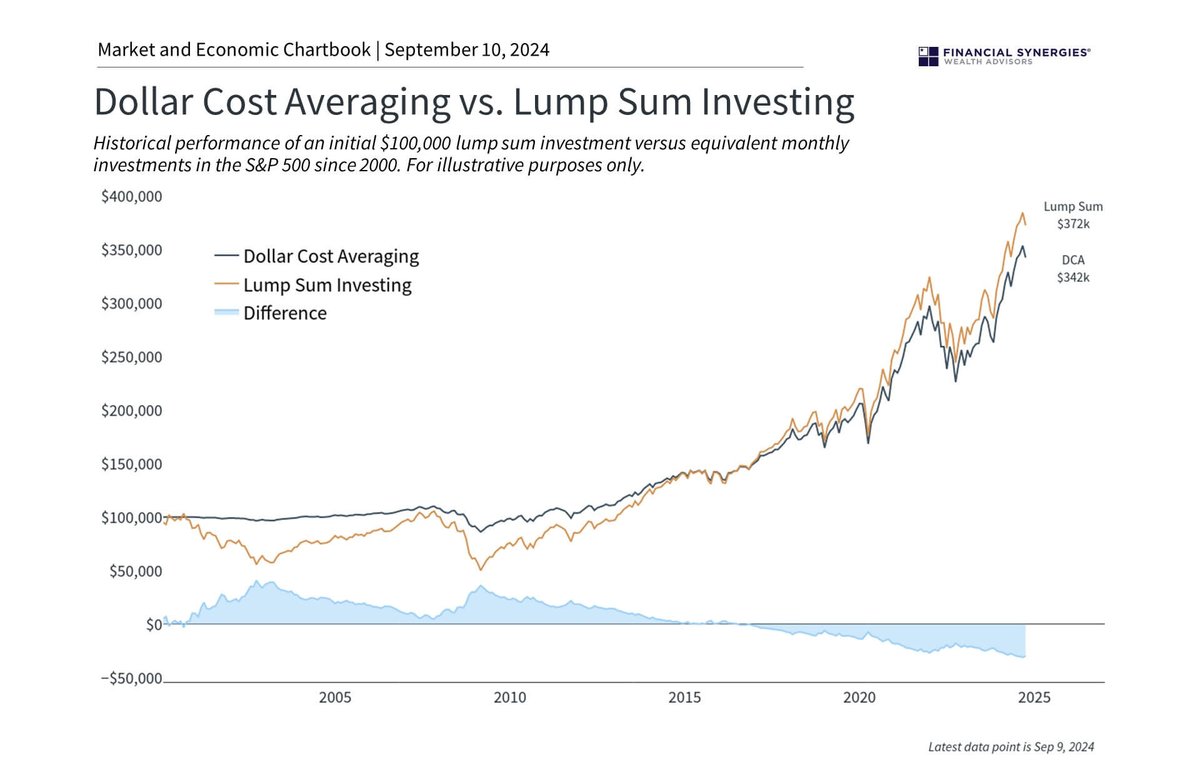
If you have a lump sum, statistically, investing it all immediately beats dollar-cost averaging about 65% of the time. Markets go up more often than they go down, so getting money in sooner captures more growth.
But statistics aren't psychology. The 35% of the time when DCA wins? Those are usually during market crashes. And the emotional pain of investing $50,000 the week before a 20% drop causes people to panic-sell, locking in losses that dwarf the statistical advantage of lump sum investing.
I split the difference. Invested $30,000 immediately, DCA'd the remaining $20,000 over four months. Not optimal mathematically, but optimal for my sleep.
How DCA Actually Works
Simple: invest the same amount on a regular schedule regardless of what the market is doing. $500 every month. $1,000 every two weeks. Whatever fits your cash flow.
The magic is automatic. When markets are high, your fixed amount buys fewer shares. When markets are low, it buys more shares. You're buying more when things are cheap and less when they're expensive, without having to make any decisions.
My 401(k) contribution is the ultimate DCA setup. Every paycheck, same amount, regardless of market conditions. I don't think about it. I don't worry about timing. It just happens. Over 14 years, that automation has built a substantial portfolio.
When Lump Sum Makes Sense
If you genuinely don't care about short-term volatility, lump sum statistically wins. If the money is already invested (say, in a taxable account) and you're just switching to a better fund, lump sum makes sense. If you have a long time horizon (20+ years), short-term drops barely matter.
But most people aren't robots. Most people feel losses twice as strongly as gains. If seeing your $50,000 drop to $40,000 in month one would make you sell everything, then DCA is better for you. The slight statistical disadvantage is worth the behavioral benefit.
Practical DCA Setup
Pick an amount you can afford consistently. Set up automatic transfers from your bank to your brokerage. Buy the same funds every time. Then forget about it. Seriously. The checking your portfolio daily thing? Stop doing that. Monthly reviews are plenty.
I recommend broad market index funds for DCA. VTI (total US stock market), VXUS (international), BND (bonds). Simple, cheap, diversified. The asset allocation planner on this site helps you figure out the right mix.
The best investment strategy is the one you'll actually stick with. If DCA helps you sleep at night and keeps you invested through downturns, it's the right strategy for you. Math is important, but behavior is everything.
The Volatility Reduction Effect
DCA's real superpower isn't higher returns. It's lower emotional volatility. When you invest the same amount every month, you naturally buy more shares when prices are low and fewer when prices are high. This "buy low" effect reduces your average cost per share over time.Try Our Compound Interest Calculator
Model how regular contributions grow with compounding over time.
Calculate NowAll data stays in your browser — we never see it.
Mathematically, DCA produces a lower average cost per share than the average price during the period. It's called the "dollar-cost averaging arithmetic." In a volatile market, this effect is stronger. In a steadily rising market, it's weaker.
During the 2022 bear market, DCA investors were buying more shares every month as prices fell. When the market recovered in 2023, those extra shares amplified their gains. Lump sum investors who invested in January 2022 had a rough year. DCA investors had a less rough year and ended up with more shares.
DCA for Windfalls
If you receive a windfall (inheritance, bonus, sale of a business), the research suggests lump sum wins 65% of the time. But if losing 20% immediately would cause you to abandon your strategy, DCA over 6-12 months is perfectly reasonable.
My approach with the $50,000 from my aunt: I invested $30,000 immediately because the money was already effectively invested (sitting in a money market). The remaining $20,000 I DCA'd over 4 months. Not optimal mathematically, but optimal for my psychology.
Automating DCA
The best DCA setup is one you never have to think about. Automatic transfers from checking to brokerage. Automatic investments into index funds. Then ignore it. Don't check your portfolio daily. Don't read market news. Don't try to time the market.
I check my investments once a month, on the first Sunday. I rebalance if needed. The rest of the time, I let the automation work. Cooper and I have better things to do, like arguing about whether it's walk time.
Final Thoughts
Look, I'm just a guy in Denver with a spreadsheet habit and a dog who sheds too much. I don't have a crystal ball. I can't predict where the market is going next month or next year. Nobody can, despite what they might tell you on TV.
What I can do is show you the math. The numbers don't lie, even when we want them to. Compound interest works. Fees matter. Diversification protects you. Time is your greatest asset if you're young, and your greatest concern if you're not.
The tools on this site are free because I believe everyone deserves access to honest financial analysis. No sales pitch, no hidden agenda, no commissions. Just data and my occasionally sarcastic commentary.
If you take one thing from this article, let it be this: small decisions made consistently beat perfect decisions made occasionally. Start where you are. Use what you have. Do what you can. The rest is just compounding.
What I Learned from 14 Years in the Industry
After analyzing thousands of portfolios at three different firms here in Colorado, I've developed a few principles that guide everything I write on this site. These aren't fancy theories from textbooks. They're observations from real people with real money making real mistakes.
First, complexity is the enemy of execution. The more complicated your investment strategy, the less likely you are to follow it consistently. I've seen PhDs in mathematics fail at personal finance because they couldn't stop tinkering. Meanwhile, my neighbor who barely graduated high school built a $2 million portfolio using nothing but a target-date fund and automatic contributions. Simplicity wins because simplicity is sustainable.
Second, behavior matters more than knowledge. Everyone knows they should buy low and sell high. But when the market drops 30%, emotions take over. I've watched incredibly smart people panic-sell at the bottom and miss the recovery. The best investment strategy is the one you'll actually stick with when things get ugly. That's usually the boring strategy.
Third, fees are the only thing you can control. You can't control market returns. You can't control inflation. You can't control what the Federal Reserve does. But you can absolutely control how much you pay in investment fees. And over decades, that control is worth hundreds of thousands of dollars.
Cooper is scratching at the door now, which means it's time for our afternoon walk along the South Platte. Before I go, let me leave you with this: the best financial decision you can make today is the one you actually follow through on. Not the perfect theoretical strategy. The one you implement. The one you stick with. The one that becomes a habit.
That's just my take. I'm a guy with a spreadsheet and a shedding dog. Do your own homework. And if you found this helpful, try one of the calculators on this site. The numbers might surprise you.
Lump Sum vs DCA: The Academic View
Vanguard published a famous study in 2016 comparing lump sum investing to dollar-cost averaging. They looked at every 10-year period from 1926 to 2015 across US, UK, and Australian markets. Lump sum won about two-thirds of the time. The average outperformance was roughly 1.5-2.7% annually depending on the market.
So academics say: if you have the money, invest it immediately. The odds are in your favor. Markets go up more often than they go down, so getting money in sooner captures more growth.
But the study also acknowledges that DCA provides "peace of mind" and reduces regret. For investors who would lose sleep over a market crash the month after investing, DCA is a reasonable trade-off. The slight underperformance is the price of emotional stability.
My take? The study is right on the math, but wrong on human behavior. Most people aren't robots. Most people feel losses twice as strongly as gains. If DCA helps you stay invested through volatility, it's worth the small statistical cost. The alternative is panic-selling and locking in real losses, which costs way more than 1.5%.
Tools That Help
I built several free calculators on this site specifically to help with the concepts discussed in this article. They're all browser-based, no signup required, and your data never leaves your computer.
Try plugging in your actual numbers. Adjust the assumptions. See what happens when you change the time horizon or the rate of return. The best financial decisions are informed ones, and these tools give you the information you need.
If you find a bug or have a suggestion for a new calculator, email me at privacy@investcomparetool.org. I read every message, though it might take me a week or two to respond. Cooper keeps me busy.
M
About Marcus Thornton
Independent investment researcher based in Denver, Colorado. Former portfolio analyst with 14 years of experience. CFA charterholder. When not crunching numbers, you'll find him skiing the Rockies or fly-fishing the South Platte with his dog Cooper.
Marcus